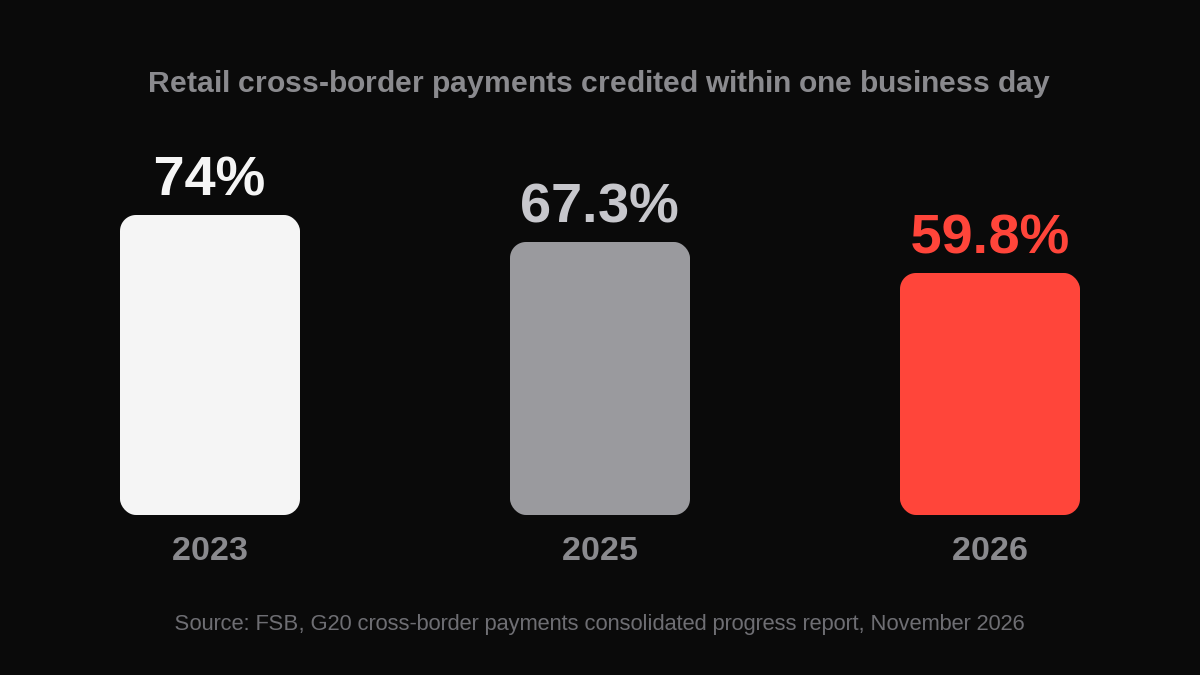
That figure comes from the Financial Stability Board's 2026 progress report on the G20 cross-border payments roadmap, published on 16 November. Here is what it found and what it means if your income arrives from another country.
What the G20 promised
In 2020 the G20 set targets for making cross-border payments cheaper, faster, more transparent and easier to access by the end of 2027. For retail payments, the speed goal is that 75% of payments are credited within one hour and the rest within one business day, and the cost goal is an average of no more than 1%. The FSB tracks progress every year.
What the 2026 report found
| Measure | Target by 2027 | 2026 |
|---|---|---|
| Retail payments credited within 1 hour | 75% | 32.9% |
| Retail payments credited within 1 business day | 100% | 59.8% (74% in 2023) |
| Average cost, person to person | 1% | 2.7%, unchanged since 2023 |
| Average cost, business to business | 1% | 1.5%, unchanged since 2023 |
The FSB describes progress as gradual and uneven across payment types and countries, and coverage of the report, such as FXC Intelligence's breakdown, notes that the 2027 retail targets look unlikely to be met on time. Wholesale payments between banks did better: more of them now arrive within an hour than in 2023. The slowdown is concentrated in the payments ordinary people and small businesses send.
Why it matters if you get paid from abroad
If you invoice clients in another country, "within one business day" is not an abstract metric. It is the difference between paying rent on time and chasing a payment that is somewhere between two banks. Four in ten retail payments now take longer than a day, and the cost of each one has not moved in three years.
Slow payments also cost money indirectly. While a transfer is in transit you can't use it, the exchange rate can move, and every extra day is a day a client might assume it already arrived.
What you can do today
- Ask how the client will pay before you send the invoice. A local bank transfer in the client's own currency is usually faster than an international wire.
- Put payment details and currency on every invoice. Missing or mismatched details are one of the most common causes of delay.
- Track the real time to arrival. Note the date the client says they paid and the date the money lands. After a few invoices you'll know which route is actually slow.
- Compare the amount received, not the advertised fee. Exchange-rate markups and intermediary charges often cost more than the visible fee.
What we're building
Hover gives you your own USD, EUR and GBP account details, so a client abroad can pay you the way they would pay someone local: with a normal bank transfer in their own currency. It doesn't change the global numbers in the FSB's report, but it can take your invoices off the slow route.
The headline from the report is simple: the world agreed to make sending money across borders faster, and for most people it got slower. If you've waited on a payment from abroad this year, you weren't imagining it.